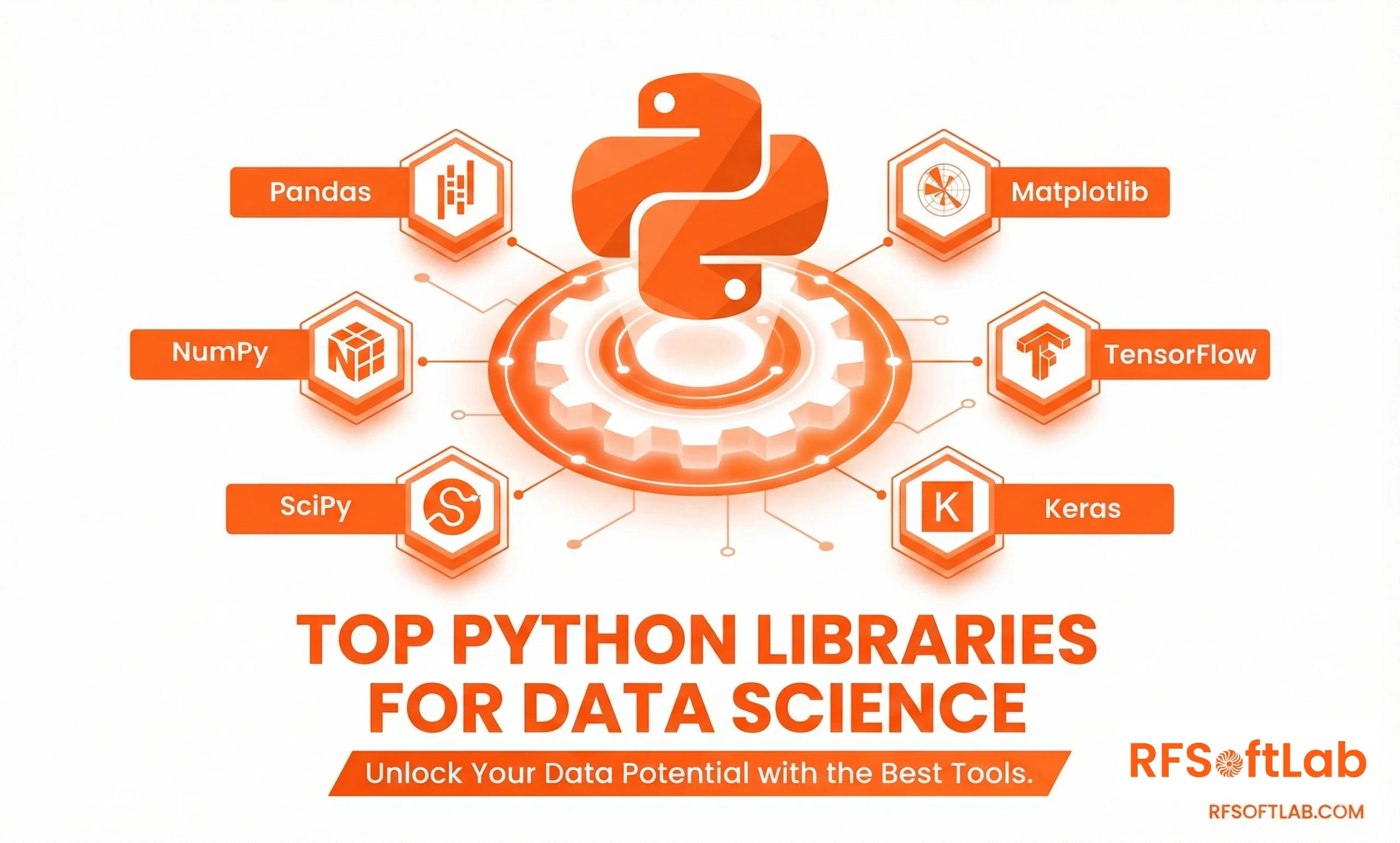
The top Python libraries for data science are evolving at breakneck speed. As we look toward 2026, the tools we use are moving beyond simple data analysis to power scalable, intelligent, and real-time artificial intelligence systems. Python, with its rich ecosystem, remains the undisputed champion for this transformation.
But the Python landscape of 2026 isn’t the same as it was five years ago. The rise of massive datasets, the demand for machine learning in production, and the need for faster performance have created a shift. This list isn’t just about the “most popular” libraries; it’s about the most essential ones. We’ll cover the timeless workhorses and the high-speed challengers you need to know to stay ahead.
Why These Top Python Libraries Will Dominate Data Science in 2026
If you’re in the tech space, you know the buzzwords: AI scalability, big data processing, and end-to-end MLOps. By 2026, these aren’t just buzzwords; they’re the baseline expectation. The libraries that will dominate are the ones that solve these problems best.
We’re moving from a world of “let’s analyze a CSV on my laptop” to “let’s deploy a real-time model that serves millions of users from the cloud.” This requires tools that are not only powerful but also fast, reliable, and production-ready. This list represents the ultimate toolkit for the modern data scientist and the forward-thinking businesses that employ them.
The Evolving Data Science Landscape: From 2025 to 2026
So, what’s changing? Three key trends are defining the 2026 toolkit:
The Need for Speed: Faster DataFrames are no longer a “nice to have.” With datasets regularly exceeding 100GB, libraries that can handle out-of-core processing and parallel execution (like Polars) are moving from the niche to the mainstream. This evolution is why the top Python libraries for data science are now focusing heavily on performance.
The Rise of Multimodal AI: The future isn’t just text or images; it’s both, plus audio and video. Libraries like PyTorch and TensorFlow are at the forefront of building these complex, multimodal AI models.
Ethical & Explainable AI (XAI): As AI becomes more powerful, the demand for transparency is growing. “Black box” models are no longer acceptable for critical applications. Tools that support Explainable AI and rigorous statistical analysis (like Statsmodels) are becoming essential for building trust and meeting regulations.
1. Pandas: The Unrivaled Data Wrangling Powerhouse
Let’s start with the classic. Pandas is, for many, the default tool for data wrangling and data analysis in Python. Its intuitive DataFrame object makes cleaning, transforming, and exploring data a breeze. For this reason, it consistently ranks among the top Python libraries for data science.
But this isn’t your 2020 version of Pandas. As we move into 2026, the library has undergone significant upgrades to address performance bottlenecks. With versions 2.2 and the highly anticipated 3.0, we’re seeing massive improvements. The introduction of Apache Arrow as a backend for string data and the “Copy-on-Write” mode becoming the default means Pandas is faster and more memory-efficient than ever.
Key Features and 2026 Predictions
- Prediction: By 2026, Pandas 3.x will have solidified its base, silencing many critics. Its main advantage will remain its massive ecosystem—virtually every other data library integrates with it. You can explore its full capabilities on the official Pandas website.
- Pro: Unmatched flexibility and a gentle learning curve.
- Con: Can still struggle with datasets that are much larger than your available RAM (which is where our next library comes in).
- Code Snippet (The Classic):
2. NumPy: The Backbone of Numerical Computing
If Pandas is the body, NumPy is the skeletal system. It’s the fundamental package for numerical computing in Python. You may not always use it directly, but the libraries you love—Pandas, Scikit-Learn, TensorFlow—are all built on top of it.
NumPy’s power comes from its ndarray (n-dimensional array) object, which provides blazing-fast mathematical operations and array manipulations backed by C. Any time you’re working with vectors or matrices, you’re using NumPy. Its importance cannot be overstated, as it underpins nearly all top Python libraries for data science.
Why It's Still Essential for High-Performance Tasks
In 2026, NumPy’s role is even more critical. As machine learning models become more complex, the need for efficient vectorization (applying operations to entire arrays at once) is paramount. The launch of NumPy 2.0 has modernized the API, cleaned up old features, and improved compatibility, ensuring it remains the high-performance foundation of the scientific Python stack.
3. Scikit-Learn: Your Go-To for Machine Learning Basics
For “classic” machine learning, there is still no better library than Scikit-Learn. When your problem involves classification, regression, clustering, or dimensionality reduction, sklearn is the first tool you should reach for. Its excellent documentation is a key reason for its popularity It’s the most practical of all the top Python libraries for data science for everyday predictive modeling.
Its power lies in its simple, consistent API. You can swap out a Random Forest for a Gradient Boosting Machine with a single line of code. With versions post-1.5, we’ve seen better model evaluation tools, more powerful preprocessing pipelines, and better handling of large datasets.
Real-World Applications in Predictive Analytics
This is where data science delivers tangible business value. Think of:
Customer Churn: Predicting which customers are likely to leave.
Fraud Detection: Classifying bank transactions as legitimate or fraudulent.
Market Segmentation: Clustering customers into groups for targeted campaigns.
This is the kind of practical, high-ROI solution we specialize in building at RFSoftLab through our advanced services in artificial intelligence.
4. Polars: The Lightning-Fast Alternative Gaining Traction
Here’s the challenger you must know for 2026. Polars is a DataFrame library rewritten from the ground up in Rust. It’s designed for one thing: speed. This makes it one of the most exciting new additions to the collection of top Python libraries for data science.
It achieves this through two key features:
Parallelism: It uses all your CPU cores automatically.
Lazy Execution: It analyzes your entire query, optimizes it, and then executes it, preventing you from making unnecessary copies or calculations.
By 2026, Polars will not be a “niche” tool; it will be a standard for any data professional working with datasets larger than a few gigabytes.
Pandas vs. Polars: When to Switch
Feature | Pandas | Polars |
|---|
Best For | Quick exploration, smaller data (<10GB), ecosystem compatibility | Large datasets (>10GB), production pipelines, performance-critical tasks |
Execution | Eager (runs code line by line) | Lazy (optimizes query first) |
Backend | Python / C | Rust |
Parallelism | Mostly single-threaded | Multi-threaded by default |
5. TensorFlow: Scaling Deep Learning at Enterprise Level
When it’s time to get serious about deep learning, you’ll likely turn to TensorFlow. Backed by Google, it’s an end-to-end platform, not just a library. Its key strength, especially in 2026, is its production ecosystem.
Tools like TensorFlow Serving allow you to deploy models at massive scale, while TensorFlow Lite (TFLite) lets you run models on edge devices and mobile phones. The official TensorFlow website is the best resource for its entire ecosystem. As companies focus on federated learning (training models on decentralized data for privacy), TensorFlow’s on-device capabilities become incredibly valuable.
Building Production-Ready Models in 2026
The 2026 pro-tip is to use the entire TFX (TensorFlow Extended) platform. This MLOps toolkit helps you manage the entire lifecycle: data validation, training, analysis, and deployment. This is where DevOps and MLOps merge, a core competency for any serious cloud services provider.
6. PyTorch: Flexible AI Innovation for Researchers
If TensorFlow is the enterprise workhorse, PyTorch (backed by Meta) is the nimble innovator. It has largely won the hearts of the research community thanks to its “Pythonic” feel and flexible dynamic computation graph, which makes debugging complex models much easier. This user-friendliness in research is a key reason it has become one of the top Python libraries for data science.
With PyTorch 2.x, the torch.compile() feature has been a game-changer, offering massive speedups that bring it into direct competition with TensorFlow on performance. It’s no longer just for research; it’s a production-ready powerhouse. You can get started at the official PyTorch website.
Why It's Poised for Multimodal AI Dominance
The most exciting 2026 breakthroughs are in multimodal AI—models that understand text, images, and speech simultaneously. PyTorch’s flexibility makes it the ideal platform for building these complex, cutting-edge architectures. This is the frontier of advanced services in artificial intelligence.
7. Matplotlib & Seaborn: Visualization Mastery
You can’t do data science if you can’t see your data. No list of the top Python libraries for data science would be complete without visualization tools. Matplotlib is the foundational plotting library—it’s powerful and customizable, but can be verbose.
This is why Seaborn is its essential partner. Built on top of Matplotlib, Seaborn allows you to create beautiful, complex statistical visualizations (like heatmaps, violin plots, and pair plots) with just one line of code. By 2026, these tools are more integrated than ever, providing the visual backbone for every Jupyter Notebook.
Creating Stunning Dashboards with Minimal Code
While Matplotlib and Seaborn are great for exploration, they are also the first step toward building interactive dashboards—a key part of any custom software development project that aims to deliver insights to business users.
8. SciPy: Advanced Scientific Computing Toolkit
SciPy (Scientific Python) is the library that picks up where NumPy leaves off. It provides the high-level functions for optimization, linear algebra, integration, and signal processing that data scientists and engineers rely on.
You may not use SciPy every day, but when you need to solve a complex optimization problem (like finding the best price for a product) or analyze a waveform, SciPy’s battle-tested algorithms are indispensable.
Tackling Complex Simulations and Integrations
SciPy is the engine behind many specialized R&D projects. It’s used for everything from simulating financial models to processing satellite imagery. This level of technical depth is often where expert IT consulting can make the biggest impact.
9. Keras: Simplifying Neural Networks for All Levels
If TensorFlow and PyTorch seem intimidating, Keras is your entry point. It’s a high-level API for building and training neural networks with an emphasis on user-friendliness and rapid prototyping. This simplicity makes it an ideal entry point for those looking to master the deep learning side of the top Python libraries for data science.
The biggest news for 2026 is Keras 3. It’s now backend-agnostic, meaning you can write your Keras code and choose to run it on TensorFlow, PyTorch, or JAX. This is revolutionary. It ends the “framework wars” for many developers.
From Prototypes to Deployment
With Keras 3, your 2026 workflow is streamlined:
Prototype quickly using the simple Keras API.
Train on your preferred backend (e.g., PyTorch for its flexibility).
Deploy on another (e.g., TensorFlow Serving for its production strength). This “write once, run anywhere” capability is a massive boost to productivity.
10. Statsmodels: Statistical Modeling for Rigorous Insights
While Scikit-Learn gives you a prediction, Statsmodels gives you an explanation. This library is for the data scientist who needs statistical rigor. It provides tools for deep statistical analysis, econometrics, and time-series forecasting.
Its 2026 superpower is its role in Explainable AI (XAI). When you use a model from Statsmodels (like an OLS regression or SARIMA time-series model), you get p-values, confidence intervals, and detailed summaries. You can explain exactly why the model is making its predictions.
Forecasting Trends with Econometric Precision
Need to forecast sales for the next four quarters? A SARIMA model from Statsmodels is often more robust and far more explainable than a complex neural network. In a world demanding ethical and transparent AI, this classical library is more important than ever.
Beyond the Libraries: Why Your Data Science Partner Matters
This list of the top Python libraries for data science is powerful. But let’s be honest: tools are just tools. The real business value comes from the expertise to choose the right tool for the job and integrate it into a seamless system.
A craftsman knows when to use a chisel and when to use a sledgehammer. A data science expert knows when to use Scikit-Learn for a simple, fast model and when to build a complex PyTorch solution.
How RFSoftLab Transforms Data into R.O.I.
At RFSoftLab, we don’t just use these top Python libraries for data science; we masterfully integrate them into end-to-end solutions that drive real results.
Our expertise in advanced services in artificial intelligence and machine learning means we choose the right tool for your specific problem. We build the custom software development and mobile app creation that brings your models to your users. We manage the cloud services and DevOps (MLOps) pipelines to ensure your models run reliably at scale. Our IT consulting and digital marketing teams ensure your final product succeeds in the market, and we can even provide offshore software development to scale your team’s capabilities and budget.
We are the partner that bridges the gap between raw data and a tangible return on investment.
How to Use These Top Python Libraries for Data Science: Installation and Best Practices
Ready to build your 2026 toolkit? The best practice is not to install these system-wide. Always use a virtual environment (venv or conda) to manage your projects.
Here’s your “cheat sheet” installation command:
Pro Tips for Integrating These Libraries Seamlessly
To get the most from the top Python libraries for data science, follow these best practices:
- Use Virtual Environments: I’ll say it again. It’s the #1 rule. It prevents “dependency hell” and makes your projects reproducible.
- Combine Strengths: Don’t be a purist. Use the best tool for the job. A common 2026 workflow is to use Polars for lightning-fast data cleaning on a 100GB file, then convert just the fraction you need to a NumPy array (
.to_numpy()) to feed into a Scikit-Learn or TensorFlow model.
What's Next? Emerging Libraries to Watch
This list of the top Python libraries for data science is your 2026 foundation, but the field is always moving. Keep these on your radar for 2027:
JAX: Google’s high-performance computing library for in-place function compilation, especially popular in advanced research.
Hugging Face Transformers: The de facto library for all things Natural Language Processing (NLP). It’s an essential part of the modern AI stack.
RAPIDS (cuDF): An NVIDIA project that re-implements the Pandas (cuDF) and Scikit-Learn (cuML) APIs to run directly on your GPU, offering speedups of 100x or more.
The future of data science is being built today. By mastering these essential Python libraries, you’ll be well-equipped to build the next generation of intelligent applications.