The Hidden Cost of Curly Braces
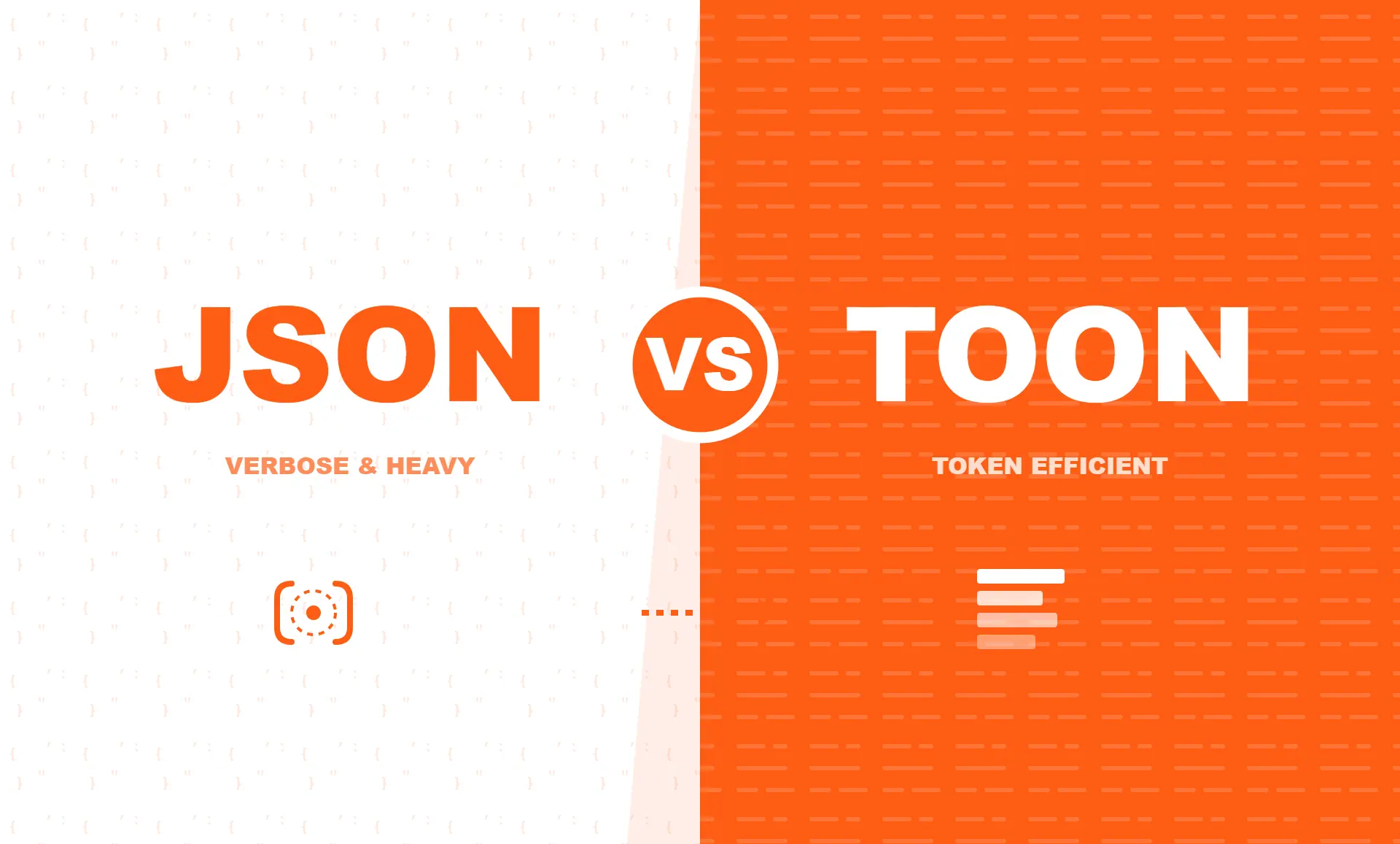
For over two decades, JSON (JavaScript Object Notation) has been the undisputed king of data interchange. It powers the web, our APIs, and our databases. But as the world shifts rapidly toward Generative AI and Large Language Models (LLMs) like GPT-4, Claude, and Gemini, a crack has appeared in JSON’s armor. The problem isn’t functionality—it’s cost.
In the world of AI, you pay for tokens, not just bandwidth. Every curly brace {}, every quotation mark "", and every comma , in a JSON file counts as a token. When you are processing millions of API requests, this “syntax sugar” becomes a massive financial drain.
Enter TOON (Token-Oriented Object Notation).
Trending wildly among AI architects and developers in late 2025, TOON is being hailed as the “JSON killer” for AI applications. It promises to slash token usage by 30% to 50% without losing data structure. But is it just hype, or should you rewrite your pipelines today?
In this comprehensive guide, we’ll break down TOON vs. JSON, explore why token efficiency matters, and how forward-thinking partners like RFSoftLab are helping businesses transition their AI infrastructure to these modern, cost-saving standards.
What is TOON (Token-Oriented Object Notation)?
TOON is a lightweight, human-readable data serialization format designed specifically for the way LLMs “read” and generate text. Unlike JSON, which was built for JavaScript engines, TOON is built for tokenizers.
Its core philosophy is minimalism. It strips away the redundancy that humans and traditional parsers need (like heavy punctuation) but that modern AI models can infer from context and indentation.
The Key Difference at a Glance:
JSON: Explicit, verbose, rigid syntax (brackets, commas, quotes).
TOON: Implicit, whitespace-sensitive, minimal syntax (looks like a clean YAML/CSV hybrid).
The Battle: TOON vs. JSON – Feature by Feature
Let’s dive deep into the metrics that matter for your AI stack.
1. Token Efficiency (The Money Saver)
This is the main selling point. Let’s look at a simple user profile object.
JSON Representation:
{
  "id": 101,
  "name": "Sarah Connor",
  "role": "Admin",
  "skills": ["Python", "AI", "Security"]
}
Token Count (Approx): ~35 tokens
TOON Representation:
id: 101
name: Sarah Connor
role: Admin
skills[3]: Python, AI, Security
Token Count (Approx): ~18 tokens
Verdict:
TOON reduces the token load by nearly 50%. For a company like RFSoftLab, which builds enterprise-scale AI solutions, implementing TOON for a client handling millions of prompt inputs could save thousands of dollars monthly in OpenAI or Anthropic API fees.
2. Readability and Human Error
JSON is easy to read but hard to write (miss a comma, and it breaks). TOON uses significant whitespace and minimal punctuation, making it look much cleaner—similar to YAML but without the complex nesting ambiguity that often plagues YAML users.
- JSON: Great for machines, okay for humans.
- TOON: Excellent for humans, optimized for AI models.
3. LLM Comprehension
Surprisingly, LLMs often “understand” TOON better. Because there is less syntactic noise (fewer brackets and quotes), the model focuses more on the data and less on the format. This can lead to slightly higher accuracy in data extraction tasks.
Why "Token Bloat" is the New Performance Bottleneck
In 2025, the bottleneck isn’t internet speed; it’s the Context Window. Even with models offering 1M+ token windows, filling that space with useless formatting is inefficient.
Latency: Fewer tokens mean faster generation times. TOON payloads are generated faster by AI models than JSON payloads.
Cost: AI models charge per million input/output tokens. Reducing payload size by 40% is a direct 40% discount on your infrastructure bill.
Accuracy: By freeing up context space, you can include more relevant data (like RAG context) instead of wasting space on JSON syntax.
Expert Insight:
At RFSoftLab, we have observed that switching internal data retrieval formats from JSON to TOON in RAG (Retrieval-Augmented Generation) pipelines increased retrieval speed by 25% while lowering API costs significantly.
When Should You Stick with JSON?
Despite the excitement, TOON is not a universal replacement. JSON is still the backbone of the web.
Web APIs (REST/GraphQL): Stick to JSON. The entire web ecosystem (browsers, libraries, tools) is built on it.
Legacy Systems: Migrating huge legacy databases to TOON is unnecessary.
Strict Type Safety: JSON has more mature schema validation tools (JSON Schema) compared to the nascent TOON ecosystem.
The Hybrid Approach:
The winning strategy for 2025 is Hybrid Architecture. Use JSON for your frontend and traditional backend APIs. Use TOON for the “Last Mile” communication between your backend and your LLM.
How to Implement TOON in Your Workflow
Migrating to TOON doesn’t mean rewriting your app. It involves a simple conversion layer.
1. Install a Parser
Libraries for Python and Node.js are rapidly emerging (e.g., toon-parser).
2. Convert at the Edge
When your app prepares a prompt for ChatGPT, convert your JSON data object to a TOON string.
3. Parse the Output
Instruct the LLM to reply in TOON format, then convert that response back to JSON for your application to use.
Need help re-architecting your data pipelines for AI?
RFSoftLab specializes in modernizing legacy software and integrating cutting-edge AI efficiencies. Check out our AI & Machine Learning Services.
The RFSoftLab Advantage: Future-Proofing Your Tech
Adopting emerging standards like TOON requires more than just code—it requires strategy. RFSoftLab is not just a software development company; we are innovation partners.
Whether you are building a custom Generative AI agent, optimizing a SaaS platform, or looking to cut cloud costs, our team understands the nuance of Token-Oriented Architecture.
We help you:
Audit your current AI API usage to identify “token waste.”
Implement safe conversion layers between JSON and TOON.
Build custom parsers tailored to your specific data domain.
Scale your application with robust, cloud-native solutions.
Don’t let outdated formats eat into your margins.
The Shift is Here
The “TOON vs. JSON” debate isn’t about one format killing the other. It’s about specialization. JSON won the web; TOON is winning the AI.
As we move deeper into the age of autonomous agents and massive context windows, efficiency is king. Ignoring TOON today is like ignoring JSON in 2005— you risk being left behind by faster, leaner competitors.
Ready to optimize your software for the AI era?
Partner with RFSoftLab. From custom software development to advanced AI integration, we build solutions that are ready for tomorrow.
Ready to build your first AI Agent?
Frequently Asked Questions (FAQ)