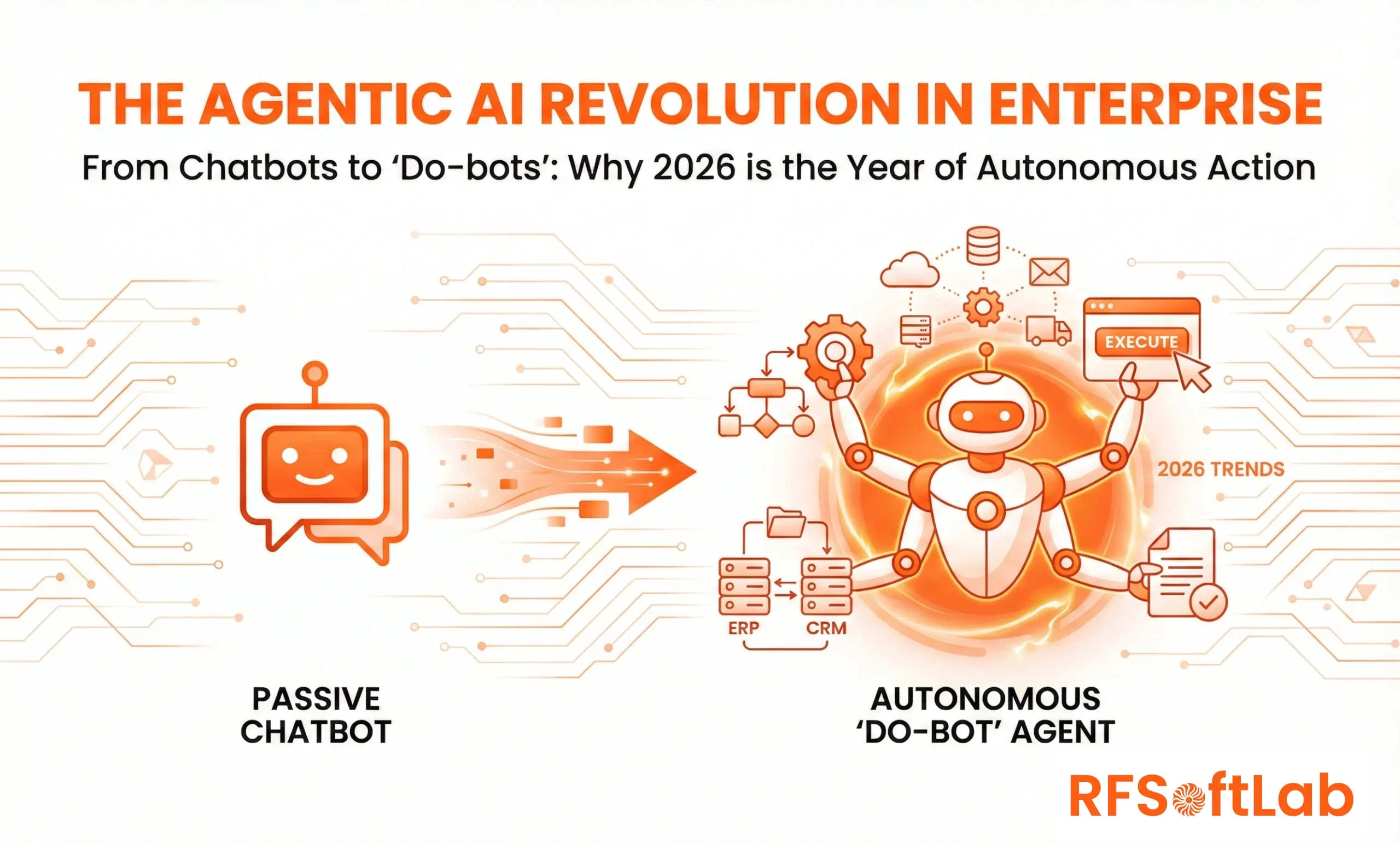
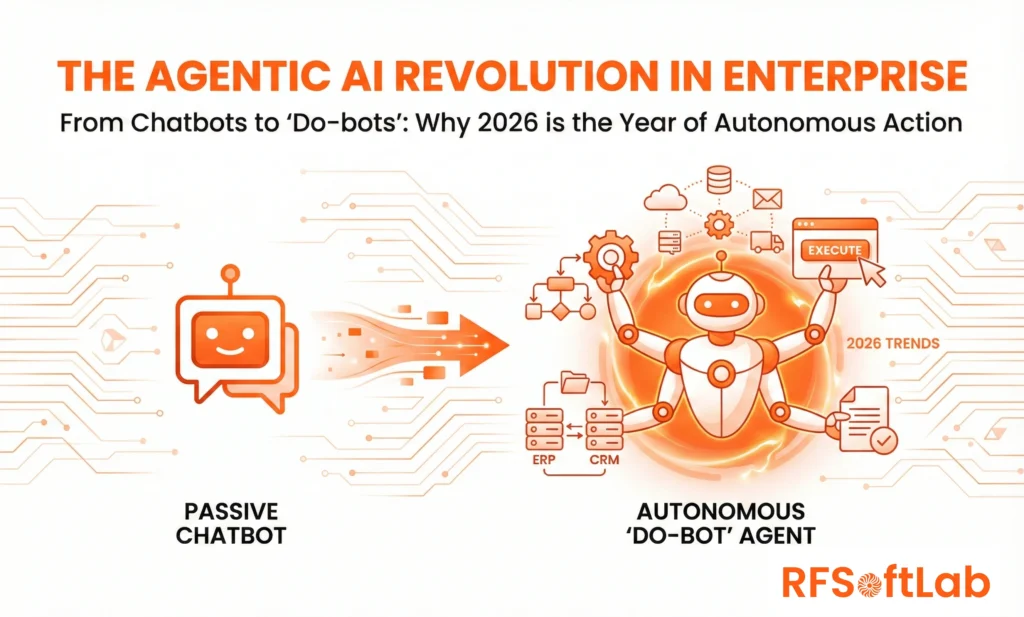
For the past two years, the business world has been captivated by Generative AI. We have all used tools to draft emails, summarize meeting notes, and generate marketing copy. But as we head into 2026, a seismic shift is transforming the technology landscape. The novelty of “chatting” with AI is fading, replaced by a critical demand for Agentic AI—autonomous systems that don’t just talk, but act.
If Generative AI is the creative intern who writes a great draft, Agentic AI is the seasoned operations manager who executes the entire project.
At RFSoftLab, we are witnessing a massive surge in inquiries for these autonomous systems. In this guide, we explore what Agentic AI is, why it is projected to be the defining tech trend of 2026, and how your enterprise can leverage it to automate complex, multi-step workflows.
What is Agentic AI? (And Why It Matters for 2026)
Most organizations are familiar with passive AI models (like standard LLMs). You ask a prompt, it provides an answer, and then it waits.
Agentic AI possesses “agency.” It transforms the AI from a passive tool into an active participant in your business. These systems can:
1. Reason & Plan
Break down a high-level goal (e.g., “Onboard this new employee”) into a sequence of necessary steps.
2. Use External Tools
Autonomously access your CRM, ERP, email client, or web browser to perform tasks.
3. Loop & Correct
If an action fails (e.g., a database connection times out), it attempts to troubleshoot or find an alternative path without requiring human intervention.
The Shift: From "Prompting" to "Delegating"
Imagine telling an AI: “Plan a logistics route for our Texas delivery fleet based on next week’s weather and current fuel prices, then update the drivers’ schedules.”
A standard chatbot would write a text-based plan. An Autonomous AI Agent built by RF SoftLab would:
Log into your logistics software.
Query the weather API and fuel price index.
Calculate the optimal route.
Execute the update directly in the drivers’ scheduling app.
Generative AI vs. Agentic AI: The Key Differences
To understand the value of enterprise AI agents, we must distinguish them from their predecessors.
Feature | Generative AI (The “Thinker”) | Agentic AI (The “Doer”) |
|---|
Primary Function | Content Creation, Summarization, Ideation | Task Execution, Decision Making, Workflow Automation |
Interaction Style | Passive (Waits for user prompts) | Proactive (Works towards a defined goal) |
Capabilities | Text, Code, Image Generation | API Calls, Software Navigation, Data Entry, File Management |
Business ROI | Employee Productivity Support | End-to-End Operational Automation |
Top 3 Real-World Use Cases for Agentic AI in 2026
1. Autonomous Customer Support Resolution
Forget simple “FAQ bots.” Agentic AI can handle complex tier-2 support tickets. If a customer requests a refund for a damaged product:
The Agent verifies the purchase in your SQL database.
The Agent checks the shipping insurance policy via a third-party API.
The Agent processes the refund in Stripe.
The Agent generates and emails the return label.
Result: Zero human touchpoints required.
2. Supply Chain & Inventory Management
In the logistics sector, speed is everything. Agents can monitor inventory levels in real-time. When stock dips below a threshold, the agent doesn’t just send an alert; it drafts a purchase order, compares vendor prices across the web, and places the order (pending a one-click human approval
3. Automated DevOps & Code Testing
In our Cloud Services & DevOps projects, we use agents to autonomously maintain infrastructure. If a deployment fails, the agent analyzes the server logs, identifies the error, and can even attempt to rollback or patch the configuration automatically, ensuring 99.9% uptime.
Why "Off-the-Shelf" Agents Often Fail
With the hype around AI, many businesses are tempted to buy generic, plug-and-play AI tools. However, Agentic AI requires deep integration with your specific business data, security protocols, and software ecosystem.
A generic agent won’t know your unique database structure, your specific compliance needs (like HIPAA or GDPR), or your internal “rules of engagement.”
This is where RF SoftLab excels. We don’t just wrap an API; we architect secure, custom AI & Machine Learning solutions tailored to your enterprise. We build strict “guardrails” to ensure the AI acts within your safety parameters—crucial for high-stakes industries like Finance and Healthcar
Strategic Roadmap: How to Adopt Agentic AI
The jump from “Chatbot” to “Agent” requires a strategic partner. Here is our recommended roadmap for 2026:
1. Identify High-Friction Workflows
Look for processes that require employees to switch between multiple software apps and perform repetitive data entry.
2. Audit Your Data Infrastructure
Agents need clean, accessible APIs to make decisions.
3. Start with a Pilot
Build a pilot agent for a single internal process (e.g., automated employee onboarding or invoice processing).
4. Partner with Experts
Work with a team experienced in AI integration to ensure your agents are scalable and secure.
The Future is Autonomous
The era of AI as a passive assistant is ending. The future belongs to businesses that deploy AI as an active, autonomous workforce. Whether you need to streamline operations, reduce overhead, or scale faster, Agentic AI is the key strategic unlock for 2026.
Ready to build your first AI Agent?
Frequently Asked Questions (FAQ)